
Dalton

When I returned to Los Angeles after earning my undergraduate degree at Berkeley, I got a job working for a wildly successful film producer and took a room for rent with my friend Dalton.
I lived with him through my twenties. In that time, he became far more than a landlord—he was a dearest friend, a father figure, a mother figure, a mentor, and, eventually, my family. Dalton is the reason I did not become a mess.
Fifteen years older than me, Dalton had a voltage I don’t quite have the craft to articulate. He was hysterically funny, brutally honest, effortlessly charming, and wildly stylish—save for the summer of blond highlights, which even he conceded was a lapse in judgment. His wit could turn caustic—surgical, often bitchy—and he never pretended otherwise. Listening to him dress someone down in that big Arkansas nelly twang was a masterclass, especially when the target had it coming.
He loved with operatic excess. If he found a shoe he liked, he bought eight pairs—one in every color. He phoned in votes to reality shows with civic dedication, maxing out the limit. A passing thought about chili in mini Frito bags became a cookout for fifty. Thanksgiving was art-directed within an inch of its life: mashed potatoes in martini glasses; a shrimp boil poured onto newspaper in the backyard, no utensils, no apologies.
He loved a full house and loved it more when everyone left. He sort of hated everyone. Everyone but me. For reasons I never understood, he adored me. I was young and annoying in precisely the ways he typically found intolerable—but I was his young, annoying thing, so he had absorbed me into his mischievous and wild immune system and was protective of me.
Yet he disguised that devotion in a surliness I came to treasure. With me, he was always playing wicked stepmother. I’d slip in the front door and he’d call down the hall, “NOPE. Whatever you’re doing—it’s wrong. Better start over.” Then he’d dissolve into a private giggle. I’d poke my head into his room, and without breaking his concentration on American Idol, he’d playfully snap at me: “Nooooope. No. No. Nooo. Wrong.” I’d beam.
One morning he came downstairs, studied me over his coffee, and delivered a verdict: “Well. You’re never going to be better-looking than you are today. This is it. So use it. Whatever you can possibly squeeze out of this life with your looks—do it today.” And he walked out, leaving me stunned over my Cheerios.
“Today’s the day!”
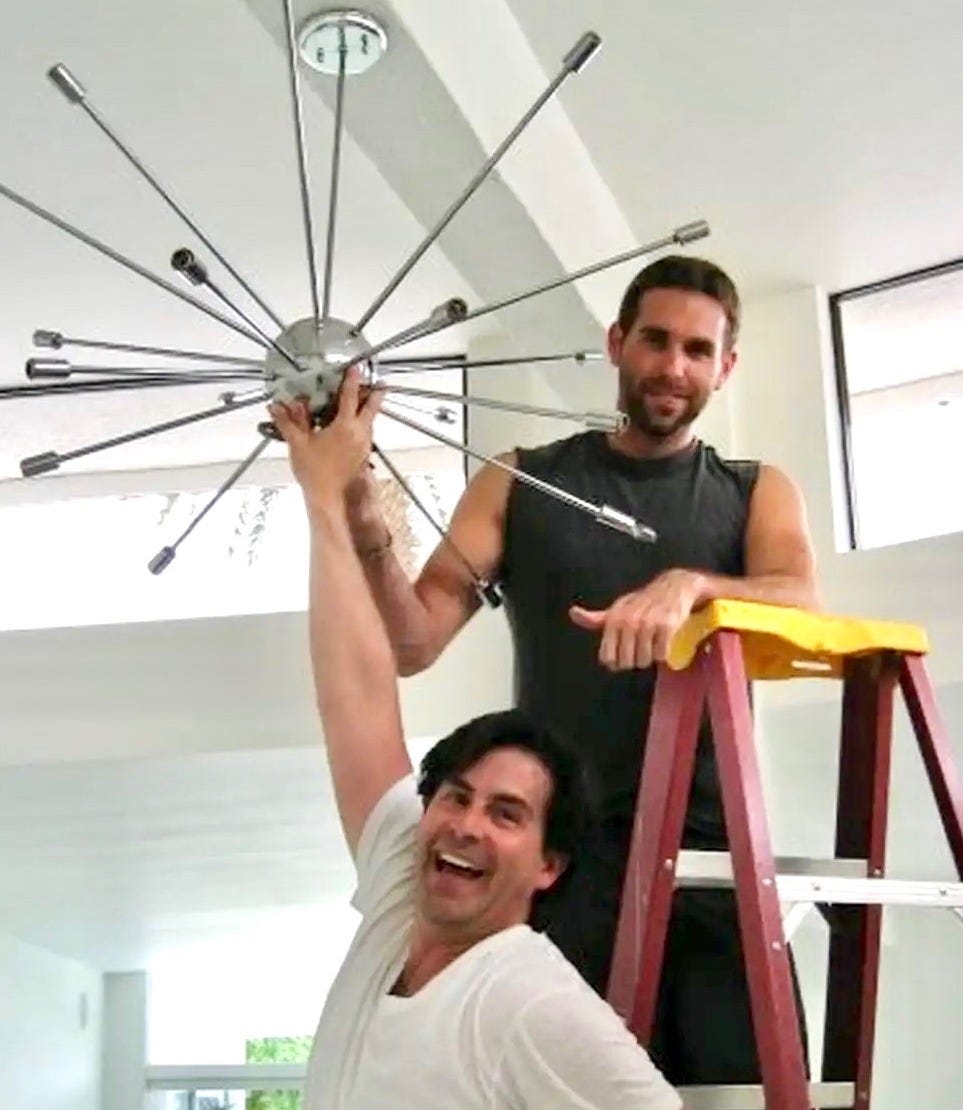
When I decided on a whim one day to quit my lucrative Hollywood job and go to acupuncture school in 2002, Dalton never questioned it: parts of us die and are being reborn all the time. He supported my evolving–even if it meant evolving away from him–which only now do I recognize is the generosity of a true friend.
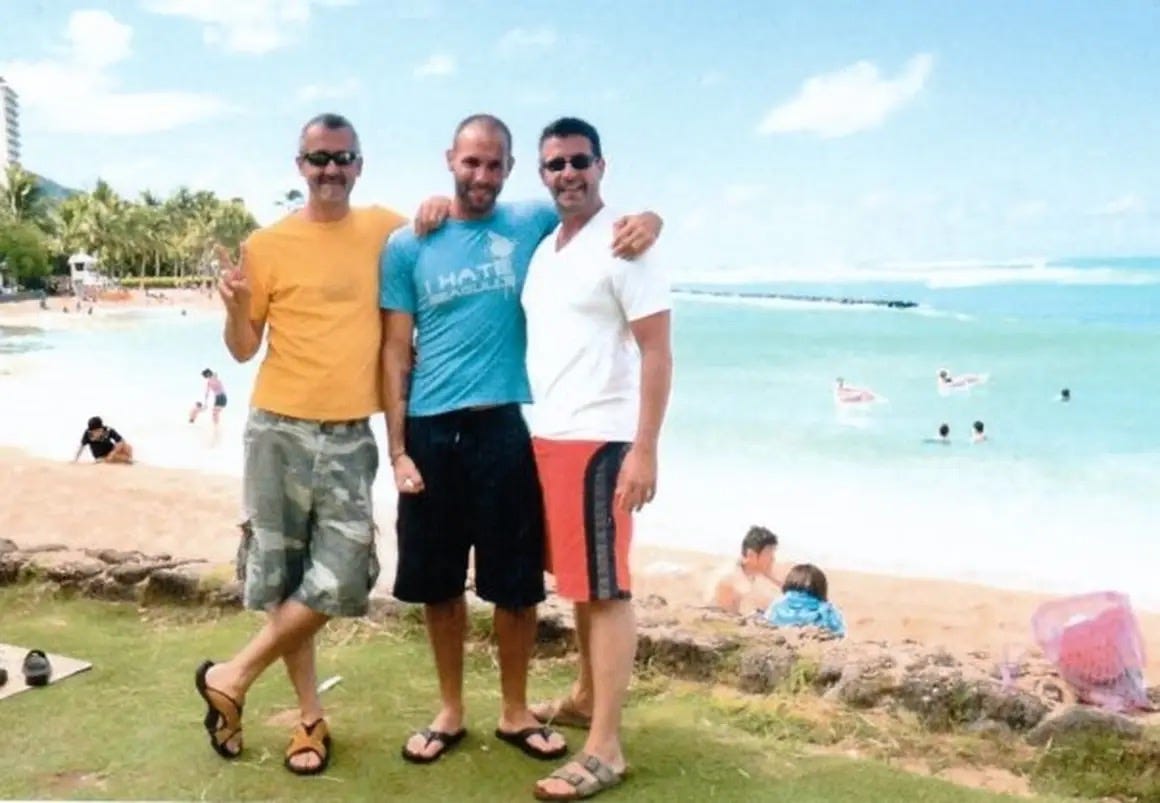
He essentially stopped charging me rent, silently adapted to my midterm and finals schedule by keeping the refrigerator more stocked than usual for certain weeks. During one particularly stressful semester, he decided we should go to Hawaii and arranged to use his miles to get us there, on a random Tuesday. I was miserable in Shang Han Lun class when i got a text on my pre-smartphone Nokia, “Go to LAX right now.”
He wanted more for me than he had for himself. He made me buy a suit and nice shoes (“You’ll need them.”) He thought I was too good for anyone I ever dated but still insisted he would walk me down the aisle someday; my moms would have to get over it. We sat on our back porch most summer nights; he chain-smoked (because of course he did) and we laughed and laughed. He radically expanded the scale of my life. His spirit was wild; he was all Fire like I had never known. I didn’t know how much that fire cost him.
Twenty years ago this week—just as I was about to start treating my first patients—Dalton asked me to deliver some furniture to Palm Springs. He said he’d meet me there. He didn’t. When I came home, he wasn’t there either. His cell phone sat on the counter beside containers of his secret candy—normally under lock and key—and a refrigerator full of home-cooked meals.
He wasn’t there because he had taken his life. And stocked the fridge, with the last meals he would cook for me.
He left a note. In it, he wrote that I had kept him alive these last few years. It completely broke my heart.
People sent food; I couldn’t eat. A friend sent a Reiki practitioner—an exquisite kindness—but I lay in bed, silently screaming for her to leave.
I kept his phone with me at all times. It rang constantly—loving friends, gutted and disbelieving, certain there’d been some mistake. Surely he would pick up once he saw their number. Instead they got me—raw, furious—answering, “No. He really is dead.”
Finally my friend Ruby said, gently, “Russ, I’m going to take that phone from you.”
I dropped out of school because the grief made it impossible. Grief dissolves qi, which is why the fatigue of mourning is distinctly and totally disabling. It drained my blood; my ruddy complexion turned to pallor (this is why the “color” we associate with the Metal element is white; translucent really, a perfect alabaster.) Dalton knew so many people that everywhere I went, I had grief projected onto me–“sad face” I would call it– because I was young and suicide’s blast radius does that.
I hid in the desert with Dalton’s best friend John and we shared grief. We set the bar at one task a day. Most days, we couldn’t clear it. We would go to Home Depot to buy a fan and I would be struck down in the aisle; I couldn’t remember why I was there. All I could remember was: Dalton is dead. My feet would give out. I’d tell John, “I need to go home. I need to go home now.” And John would say nothing; he knew there was nothing to say. If it wasn’t me, it would be him. I’d go straight back to bed and so would he.
The grief had its way with me: I felt thrashed about by it, like wild ocean waves that would be occasionally calm enough that you’d feel it safe to swim and then knock you down when you didn’t see it coming. I resented its cunning. You think you’ve emptied out, that there can’t possibly be a tear left in the body. Then a song slips through and you’re undone, suddenly sobbing hysterically and endlessly at the gym as if it is the first tear you ever shed, as if you were brand new. Time doesn’t matter. Every wave is the first wave.
I ate a turkey sandwich, or just the bread. And then went back to sleep. It was 2 in the afternoon.
I came back to our home in LA. Everyday, another piece of furniture was removed; the art didn’t belong to Dalton, and nothing belonged to me. They repossessed his car. The plants died. The food in the cupboards rotted and I didn’t have the decency or the mercy to throw it away. Dishes stacked in the sink. I stopped turning on the heat—Dalton had always governed the temperature, and I didn’t feel authorized—so the rooms went bone-cold. The house held its breath, as if waiting for its real owner to return.
I developed a night time anxiety about whether or not to sleep with my bedroom door closed. To leave it open meant I lived alone; I shared the house with no one. But to close it meant that I wouldn’t hear if he came home in the middle of the night, which some part of me assumed he would, the same small part of me that still does. I landed on sleeping with it cracked open just the slightest bit, so I could keep an ear open for his footsteps coming up the stairs, coming back to his room, coming home.
Eventually, I began treating patients in the clinic, but I was still in so much pain, faking it. I worried my sorrow would seep into every treatment, that grief would inhabit every needle. I asked my mentor, the great Dr. Yvonne Farrell, “How can I help anyone if I am consumed by this much grief?”
She told me I should not worry about that, because she knew the truth I didn’t yet: grief is always a part of care. Care is love that is tending to its own fragility and transience. Care is connection, foretelling its dissolution. Care is the part of love that knows it will die.
This bond between care and grief is embodied in the acupuncture point Lung 9, Tai Yuan—“Great Abyss.” As the Earth Point on the Metal channel, LU-9 describes the inseparability between how we tend and nurture each other and how we let each other go. LU-9 is the alloy between nourishment, mothering, and softness with the devastation of grief, the coldness of loss. The taste of Earth is sweet—the sweetness of goodbye, the deep, tender mercy that arises when we witness something we love vanish, and allow it to.
As the years passed, the sweetness surpassed the grief, and I worked to make sense of his death. I did the private detective work the living do after suicide—posthumous diagnoses, tidy narratives, arguments on his behalf. I reasoned it through, defended it to the still-angry, the inconsolable. I thought if I could understand it, I could forgive him; if I could forgive him, it would hurt less. It felt mature to endow his death with meaning—order, even goodness.
But as I’ve gotten older, I feel less compelled to mine reason or meaning out of death, because trying to do so is often just a way to feel less, to convince myself I am not entitled to be hurt. I wanted to rationalize his pain so as to negate mine. Now I think both pains have dignity and deserve grace; I like them living together.
My heart broke when he died. It’s still broken. It feels important that I not lose that, that I not brush it aside or intellectualize myself out of it. Twenty years later, I can just be within the loss, like an early morning swim in a smooth, still lake.
Loss asks us to release human ethics or reason: the cosmos gives and takes according to its own grace and intelligence, which is ultimately unknown to us and unknowable. We must learn to face the darkness without demanding we find light there.
This is Autumn. The waning light reminds us that all is impermanent, fragile, slipping through our hands. No part of life is yours to keep. We must allow the things we love to die and fade away with ease, like the fragrant warmth of blankets pulled fresh from the dryer. Of course you’d keep them if you could. But you can’t. They were never yours.
And in letting go, you feel the clarity and poignancy that is the point of grief: loss gifts you the radiant beauty of living as seen from the edge of its own vanishing.
The sun sets early, and you say, “It was beautiful. It wasn’t mine, but wow, it was beautiful.”
I went to go visit John a few weeks ago. He had digitized some old photos and we blasted through them. We laughed about Dalton–his style, his frosted tips, that summer he was an ill-advised blond. The year he broke his foot, we’re still not totally sure how; his story never really added up. Pictures from Hawaii. From Cape Cod. The zoo. It wasn’t so sad anymore. It was all love.
We landed on one particular photo and there was something about Dalton in it. He was posed just so, something about the arch of his hand, almost impossibly bent, a little gay flourish. He was so fully himself in this photo, from his turned out feet to the effete tip of his pinky finger; whatever spirit he was in this lifetime–whatever tortured but beautiful magic that innervated his body and brought him to life¬had been entirely captured by this cheap 1998 disposable camera, and printed at some CVS photo department on Santa Monica Blvd.
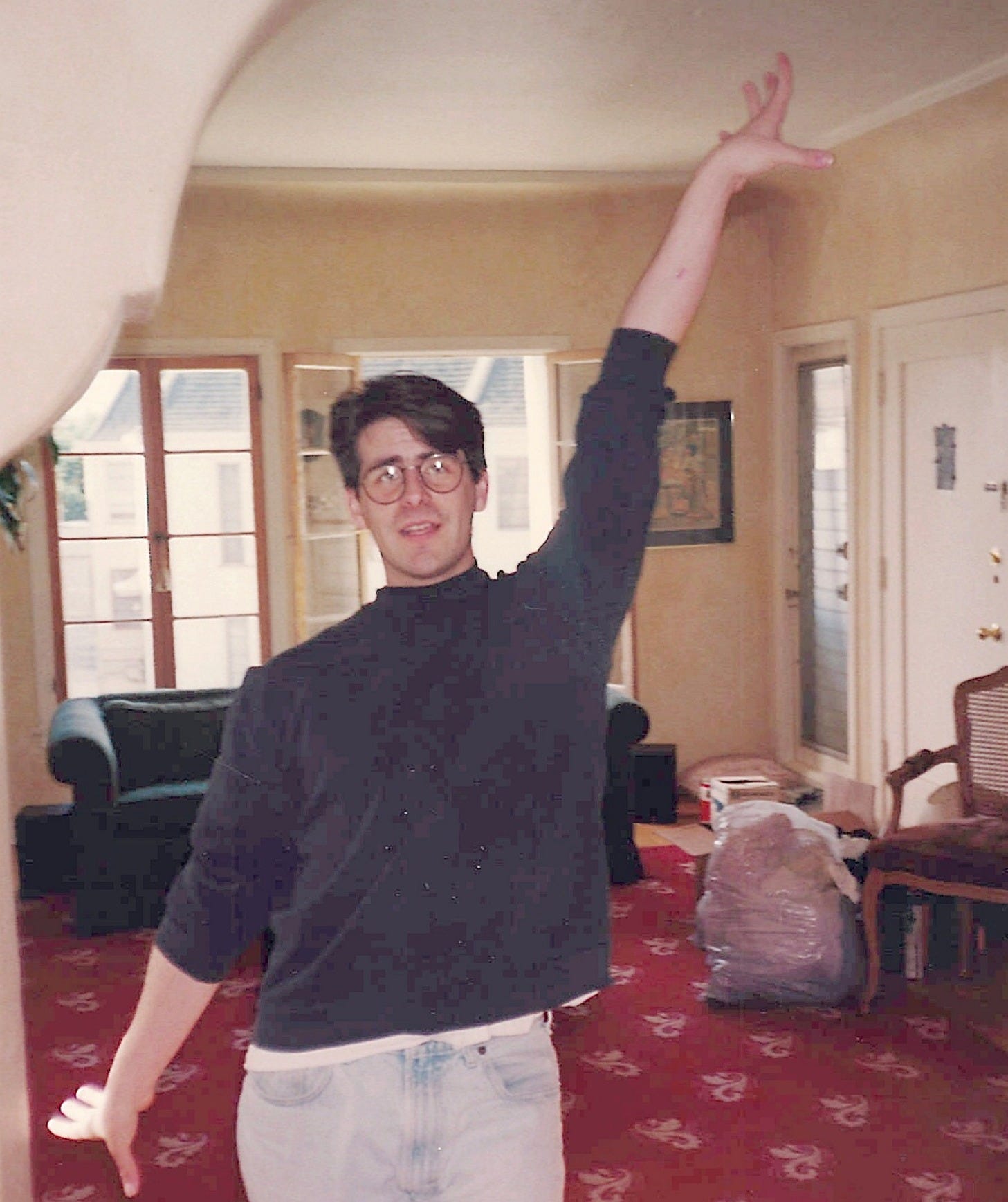
I couldn’t help but cry. John said, “I know, right?” I had forgotten. That spirit never went anywhere. I hadn’t lost it. I had simply forgotten—and now, here it was, alive and in full fluorescent display, just for me. Nothing is lost. What I loved is still here.
It’s in the places I’ve lived that he would have hated. In my relationship with my idiot boyfriend, whom he never met. In John, in our friends who loved him. In my work, in the care I give my patients.
Dalton is in my acupuncture studio, in the wood, the plaster, the stars. In the clouds I watch on morning walks with my dog, Backpack. In the wind. He is everywhere—just not in his body, just not chain-smoking on our porch, shouting down the hall at me as I head to bed, the one place my ego had truly wanted him. But he is everywhere else.
The 20th anniversary of someone’s death is a totally arbitrary and meaningless milestone. But I’m thinking about him today, and I wanted to write about him. Words give form. He’s a significant part of Poke Acupuncture. It matters to me that he is written into the very fiber of this project. (He died before social media; he would have developed such an unhealthy relationship to it.)
Every treatment I have ever given, every word I have ever written, is soaked in both my grief for him, and my love. His sadness, his laughter, his hope—they are braided into the DNA of my work. Every acupuncture point I have ever needled is offered in celebration and gratitude to him. Dalton is in everything I do.
This morning, I placed a needle on a patient’s wrist—LU-9, “Great Abyss.” I could feel Dalton watching. He was smiling, and playfully whispered into my ear, “NOPE. You’re doing it wrong. No, no, no. Nooooooope.
Better start over.”
Dalton Robertson 5/14/63 - 9/23/05
thank you for this, really beautiful. my best friend committed suicide in our twenties, its a certain texture of grief that lives on in so many unanswered ways. i just want to say and im sure you know this - just as Dalton gave you space to be who you are, you do that everyday with your care. when you take a seat to explain the poetry of the points after inserting them, it’s the same deep care of the person who would buy you a ticket to hawaii. 🖤
Really beautiful, my best friend suicided when I was in my early 20’s. It was shattering. You really capture that near limitless grief and how it carries on in us. As if we are no longer living our lives just for ourselves any longer.